You're feeling exhausted, in love, and uncertain of what to do now—and that's natural. The first 30 days with a baby are a crash course in a topic that wasn't thoroughly covered in childbirth school: now what? A newborn care checklist is created to help ease you in the process of caring for a newborn so you don't end up figuring it out yourself.
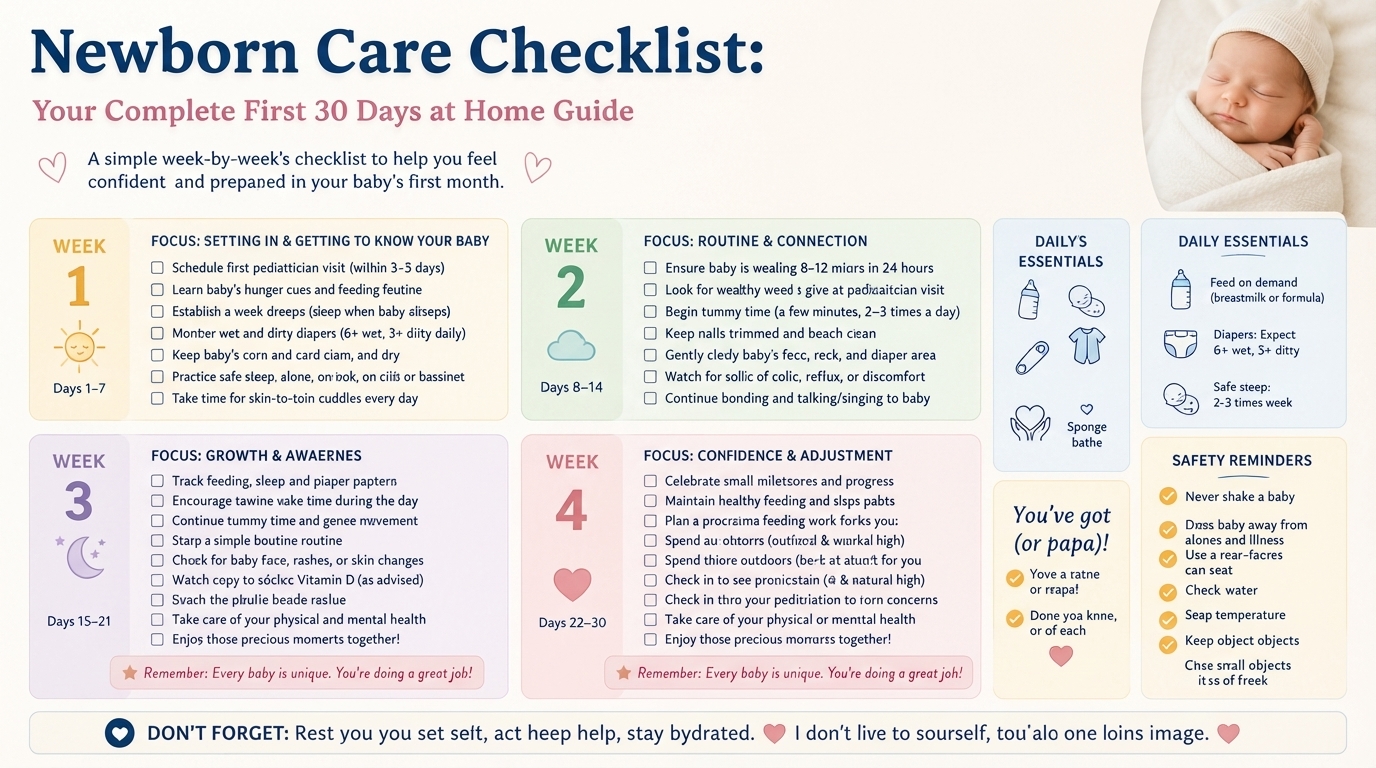
A newborn care checklist is a timeline of all the important activities, medical check-ups, feeding progress, and self-care tasks for the caregiver that are most important for the first month of life. Imagine that it is a ‘co-pilot document,' not a ‘rule book,' but a document that you will refer to when you feel exhausted and can’t remember the last feeding.
The details of every lesson are outlined below so you can see what to expect each week.
Days 1-7: Survival and Settling.
The first week is all about getting through, staying through. You have just started to read your baby's hunger cues, are just recovering from birth, and are running on minimal sleep. This week's most important item(s):
- Feed your baby every 2-3 hours (8-12 times a day)
- Observe for jaundice (yellow color of skin or eyes)
- Do not let the navel stump get wet or dirty.
- Please come to the day 3–5 pediatric weight check.
- Sleep when your baby sleeps—at least once a day.
Days 8–14: patterns begin to develop.
Small rhythms will begin to emerge at the second week. Your baby isn't on a schedule yet, but you're starting to get a better idea of when he/she is hungry.
- Note the wetness of the diaper each day (more than 6 is good hydration)
- Start tummy time 1 – 2 minutes, 2 - 3 times per day
- The umbilical cord stump should drop off; sponge baths until then only
- Establish soft limits on visitors to help ensure sleep time
- Observe and address cues to hunger, not wait for crying to occur
Days 14-20: Taking the pulse to gauge confidence and growth.
This is the time most caregivers say they felt they were gaining a footing. Your baby is definitely developing, and feeding is increasingly becoming more comfortable, and you might begin to feel a sense of rhythm. This is also a significant health marker along this path.
- Make sure you go to the 2-week pediatric visit; the doctor will monitor weight gain, feeding, and bilirubin levels.
- Baby should be at or above birth weight by day 14 and notify the pediatrician of any concerns.
- Giving the baby his/her first full bath when the umbilical stump has healed.
- Gradually build up tummy time—aim for 10-15 minutes in total every day.
- Sleep periods are becoming longer—45 to 60 minutes between sleep episodes.
- Narrate your day, sing to your baby, and talk to them; your voice is your baby's first learning tool.
- Keep an eye out for social reactions—your baby may start following your eyes and responding to your voice.
- Make a postpartum follow-up appointment (if not already made)
- See if your baby is latching or if you can assess supply if breastfeeding, with a lactation consultant if there is a concern.
Days 15-21: Getting on your feet
You're no longer in the survival phase of the acute phase. There is some measure of confidence, although not yet all that much.
- Make sure that the child visits the pediatrician for the 2-week check-up (weight, feeding, and bilirubin)
- Baby's first full bath after the falling off of the umbilical stump.
- Longer awake windows mean that they start longer periods between sleep—45 to 60 minutes between sleep.
- Review or make an appointment for a postpartum check-in with the birthing parent
- Add pacifier (if desired) after breastfeeding is established
Days 22-30: Rhythms and Growth
After the first month, feeding should be more comfortable, and you should know more about your baby than the books on your shelf.
- Go to the 1-month well-baby check-up and first immunizations
- Keep an eye out for the first social smiles around 4-6 weeks old
- Honestly monitor the condition of your mental and emotional state yourself
- Celebrate going through the toughest month of early parenthood!
When should you call the pediatrician?
One component of a comprehensive newborn care checklist is understanding what is expected and what to call the doctor. Please see your child's doctor right away if you see any of the following:
- Temperature of 100.4 F or higher (38 C or higher)
- Skin or eyes turn yellow (jaundice).
- The baby has trouble being fed or latching to the breast
- The baby will not latch or feed after going 4 hours without eating
- Frequent bouts of crying more than two hours in length of inconsolable weeping
- Breathing that is rapid, labored, or noisy
If the baby doesn't reach birth weight by Day 10. Trust your instincts. You know your baby. Never ignore a gut feeling—it's always worth calling.
A Story You May Recognize
By day four, I was crying at 2 a.m. without anything being wrong; I just didn't know if I was doing anything right, so I called the nurse line, and the first thing I heard was, "You're doing great." You called, which means you care. That was the most important newborn care skill.
This is a story of many parents' first birth, as told by me.
If you are familiar with this, you are not alone. The fourth trimester is a reality, and no one walks out of it in a nice way. The most important thing is to be there, in all ways, and with all love.
The Complete Newborn Care Checklist: First 30 Days
This checklist is for daily and weekly reference. Print it out and put it somewhere that you can see. This is not a grading rubric; it is just a guide, so you don't need to do all the items in order.
Feeding
- Feed newborn every 2-3 hours (8-12 feedings in 24 hours).
- Note wet and dirty diapers each day (24 hours)
- If breastfeeding pain does not go away after the first week, consult a lactation consultant.
- Record the day on which the baby regains birth weight (usually days 10-14)
Sleep and Safe Sleep
- Always put the baby on their back on a firm, flat surface.
- Do not fill the sleep space with pillows, bumpers, or loose blankets
- Follow your baby's sleep schedule (at least once a day).
- Maintain the room temperature in the range of 68 to 72 degrees Fahrenheit (20–22 degrees Celsius).
Health Visits
- Make and attend appointments for day 3-5 pediatric weight check
- Please ensure you attend the 2-week well-baby checkup.
- Go to a 1-month well-baby check-up and get the first vaccinations
- Ensure the newborn screening test is performed at the birth hospital
- Development and Bonding
- Start tummy time from 1 day old (30-60 min, 2-3 times a day)
- Speak, sing and look at the baby when awake
- Skin-to-skin contact is essential for bonding and thermoregulation, so have it every day.
- Wait until week 4-6 for the first social smile
- Children's Health and Wellbeing: hygiene and physical care.
- Sponge baths—until the umbilical stump falls off.
- Umbilical stump: Do not put in water; keep clean and dry.
- Use a baby file or rounded scissors to trim nails as necessary
Caregiver Self-Care
- Make one tangible offer of assistance per week and/or accept one offer of assistance per week
- Discuss and agree on a postpartum physical and emotional check-in with the birthing parent.
- Have at least one hot, substantial meal each day.
- Notice and name feeling sad, anxious, numb, etc. for a prolonged period of time
Why is the care of the newborn so overwhelming?
Newborn caregiver fatigue isn't something to be ashamed of; it's a fact of life. The effects of sleep deprivation on decision-making, emotional control, and memory are similar to clinical impairment. Include the recovery from birth, identity changes, and the huge burden of carrying another life, and you will see that you're not getting tired because you are doing it wrong. This is really difficult, and you are tired.
If you notice any of these warning signs, you may need some additional sleep:
- Suppressed feelings or lack of closeness towards your baby
- Inability to relax despite baby's comfort
- Rubbing or self-soothing behavior, such as rubbing the affected areas, more than 10 times a day for over 2 weeks
- An overwhelming sense of guilt or fear of being separated from your baby. • Excessively troubling feelings of harming yourself or your baby.
These are signs of a postpartum mood disorder, NOT a personality flaw, and can be treated successfully. Reaching out is a measure of strength and caring, not failure.
Support for caregivers who need support
There are a few sources of assistance:
Postpartum Support International: Helpline, peer support groups, and provider directory, postpartum.net
Your Pediatrician: Directly inquire about the caregiver's well-being. For most offices, there is a screening for postpartum depression at visits.
Local Parent Support Groups: Libraries, hospitals, and community centers provide free new parent groups.
Final Conclusion
There is no such thing as a "perfect month one." This is all there is: a baby who is loved, a caregiver who is trying, and a checklist to go back to when nights are too long. The difficult days will not ever last, nor will these few hard golden weeks.
You are not behind. You're in the right place and you're doing the right thing.
FAQS
The newborn care checklist is what?
A newborn care checklist is an organized list of necessary day-to-day and weekly tasks to complete within the initial 30 days of caring for a newborn: feeding, sleep safety, health care visits, hygiene, and caring for yourself. It supports overwhelmed parents to remain organized and confident throughout the most overwhelming time of parenthood.
How many times every day should a newborn be fed?
Newborns feed every 2-3 hours or 8-12 times per day. Pay attention to hunger signs—rooting, smacking lips, hand to mouth—not just by the clock.
When should I consult the pediatrician with my baby?
Contact the parents immediately if there is a temperature higher than 100.4 (38) degrees, fewer than 6 wet diapers in 24 hours, yellowing of the skin or eyes, difficulty breathing, or crying that is not consolable and exceeds 2 hours. If you're not sure, call; it's a no-brainer.
What do you look for in parents' burnouts?
Symptoms are emotional numbing, feeling detached from your baby, heightened anxiety, crying a lot for over a fortnight, and intrusive thoughts. These can be a sign of a postpartum mood disorder and should be sought in a professional.
What is a newborn care checklist?
A newborn care checklist is a structured guide covering the essential daily and weekly tasks—feeding, sleep safety, health visits, hygiene, and caregiver self-care—for the first 30 days with a new baby. It helps overwhelmed caregivers stay organized and confident during the most intense period of early parenthood.
How often should a newborn be fed?
Newborns typically feed every 2 to 3 hours, or 8 to 12 times in a 24-hour period. Watch for hunger cues such as rooting, lip-smacking, and hand-to-mouth movements rather than following the clock alone.
When should I call the pediatrician about my newborn?
Call immediately for any fever above 100.4 degrees Fahrenheit (38 degrees Celsius), fewer than 6 wet diapers per day, yellowing of the skin or eyes, difficulty breathing, or inconsolable crying lasting more than 2 hours. When in doubt, always call no question is too small.
What are the signs of caregiver burnout in new parents?
Signs include emotional numbness, disconnection from your baby, persistent anxiety, crying most of the day for more than two weeks, and intrusive thoughts. These may indicate a postpartum mood disorder and warrant professional support.