You've seen how your parents have given it their all. Now it's your turn to make an appearance for them.
This is a difficult time, however. You might feel a tension between what you're supposed to do and what the reality is. In-between love and distance. In between the things you want to do and what you can do.
You're not alone in this. Right now, thousands of families in Nepal have the same questions.
This is a guide to the difference between old-age home care and home-based care in Nepal. It talks about costs, red flags, clear thinking, and a caring heart in selecting.
When to choose between an old age home and home care in Nepal?
Nepal has definitely been blessed with a lot of weddings. In Nepali culture, the responsibility to take care of the elderly is not just a duty but an obligation. It is a sentiment of love, respect, and familial attachment. Parents and their children and grandchildren lived together for generations. In the joint family system, there was no "old lady."
However, Nepal is undergoing a transformation. There is an increase in the number of young adults relocating to cities or overseas to work. Families are smaller. Homes are busier.
It's not that love has gone away. It is the demonstration of that love that must change at times. In Nepal, it is not wrong to be a son/daughter of an old-age home. It involves coming to terms with a difficult reality with sensitivity and compassion.
What is an old age home in Nepal?
An old age home (briddhashram/senior care home) is a place where elderly persons who require some daily assistance live.
Some are run by the government. There are many that are run by NGOs, trusts, or private organizations. A shared or semi-private living environment is provided with meals, some health care needs, and social activities.
There are various old age homes in Nepal, ranging from simple shelters to more organized care homes that provide nursing care.
The basic facilities provided by an average old-age home in Nepal.
- A secure environment to live in
- One meal every 8-12 hours
- Basic medical checkups
- Support in performing daily activities
- Programs for social and religious services.
- Companionship and community
What’s Home-Based Elder Care in Nepal?
Home-based care refers to a trained caregiver who visits the parent's home every day.
This is a still-developing model in Nepal. There are a few organizations available in Kathmandu and Pokhara that provide home caregivers trained to care for older persons.
Home-based care is suitable for your parent, who still wants to live in their own home but needs assistance with cooking, cleaning, medicine, or personal care.
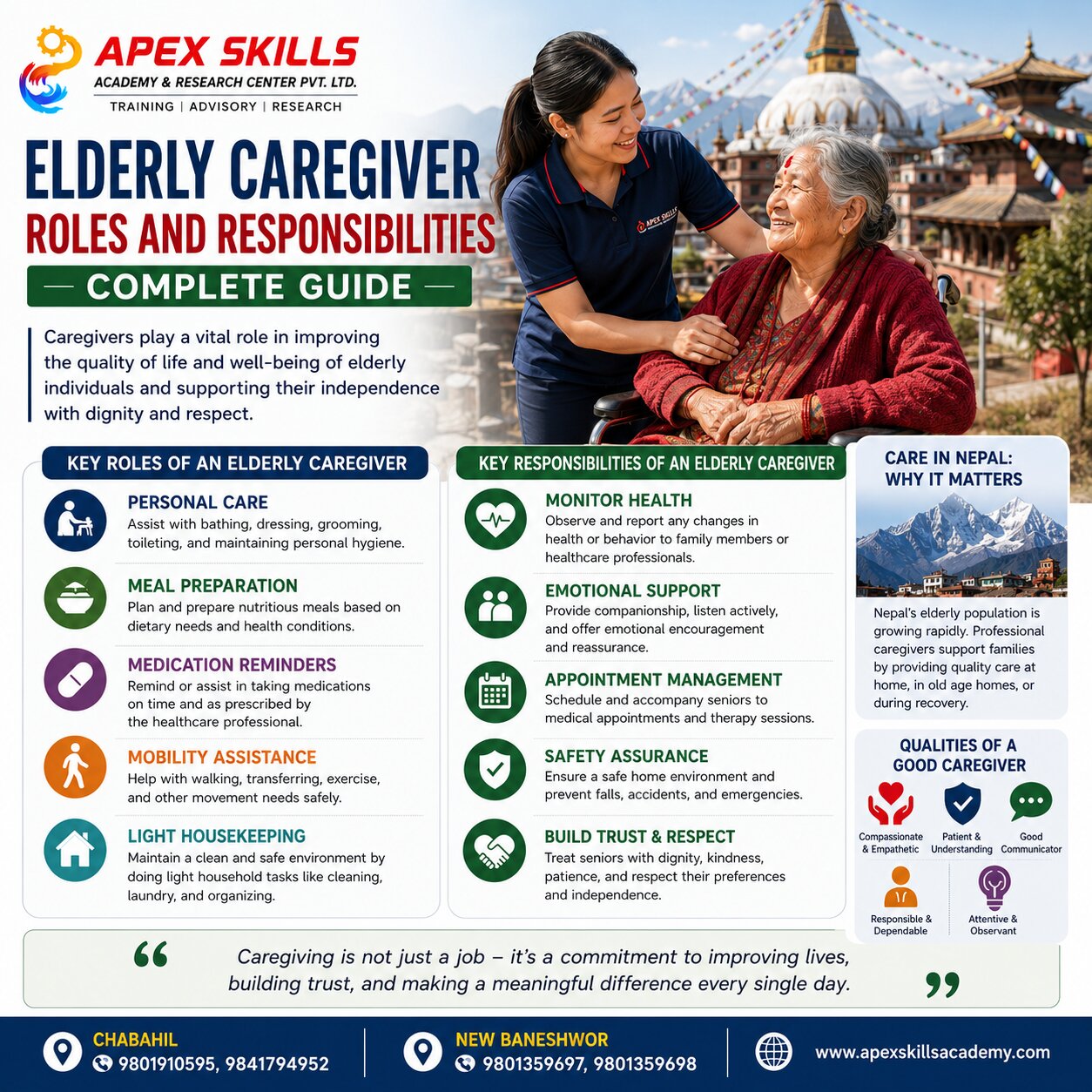
Common elements of home-based elder care in Nepal:
- A trained caregiver to visit daily
- Assist with bathing, dressing, and feeding.
- Medication reminders
- Basic health monitoring
- Supervised care for lonely elderly people
If you’re considering home-based care, one important factor is the quality of the caregiver. Professionally trained caregivers can make a big difference in safety, comfort, and dignity for your parents.
For people who want to become caregivers themselves or ensure that the caregiver they hire is properly trained, Apex Skills Academy offers a CTEVT‑aligned Elderly Caregiver Training Course in Kathmandu.
Learn more about the course here: Elderly Caregiver Training in Nepal
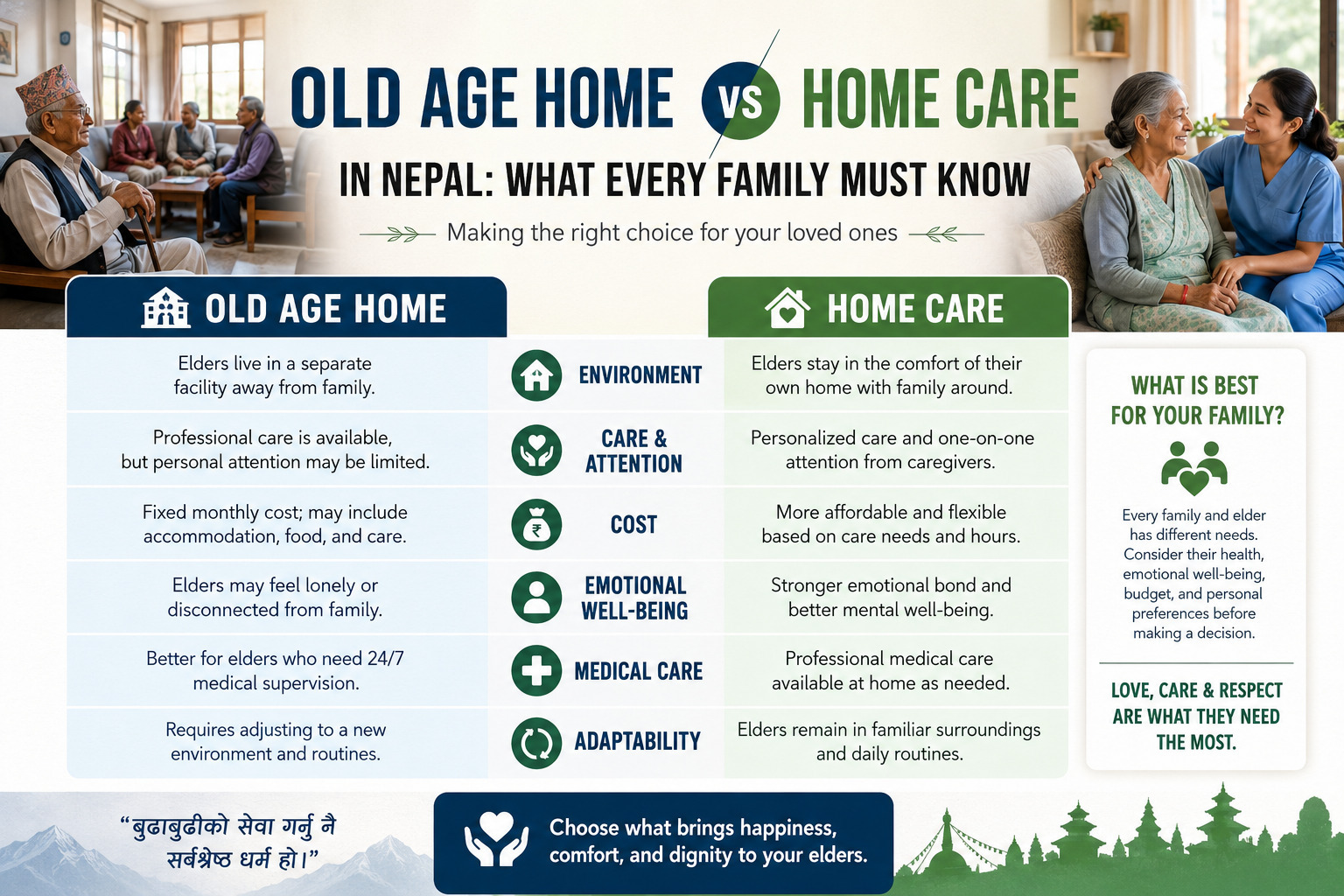
Old Age Home vs. Home Care in Nepal:
A Clear Comparison
Cost (in Nepal) NPR 8,000 to NPR 60,000 + NPR 10,000 to NPR 40,000 Family involvement visits allowed Usually high/good family availability in Nepal. Growing, primarily in Kathmandu Valley Limited, mostly urban areas Cultural comfort varies by facility. Usually higher medical support Basic to moderate (unless a nurse is hired) Monthly cost (Nepal): NPR 8,000 to NPR 60,000 + NPR 10,000 to NPR 40,000+ Best for seniors needing structure and safety Seniors who want to stay home.
Indicators that one should think about joining an old-age home in Nepal.
If you can spot these signs, you can take action before a big trouble occurs:
- Your parent has had multiple falls or near falls.
- They are neglecting food, bathing, and medicine
- Go to work for long periods or reside in another city or country.
- Your parent spends the majority of the day alone.
- No slope from the road and no ramp for safe entry into the home (broken stairs, no support rails)
- They are exhibiting memory loss and/or confusion.
- They are not as healthy as you thought.
- They require more care than you can give, and you are very tired.
If you can identify two or more of these, it's time to have an honest talk with your family and your parent's doctor.
Signs Your Parent May Need More than a Basic Old Age Home
However, some senior citizens require medical attention that most of the old-age homes in Nepal can provide. When selecting a facility with nursing assistance, take into account:
- Your parent suffers from a serious disease such as diabetes or heart or kidney disease that requires monitoring every day
- They have had a dementia or Alzheimer's diagnosis.
- They require assistance with every personal care need every day.
- They have suffered a stroke, fracture, or big surgery in the last 12 months.
- A doctor has stated that they require supervised medical treatment.
For such situations, search for private nursing homes or hospital nursing homes in Kathmandu, Pokhara, or Lalitpur. These provide more medical care.
How much does it cost to look after the elderly in Nepal?
One of the major issues for the Nepali families is cost. This is a realistic division. There are old age homes in government and NGOs. Many Briddhashrams of the government are charging very little or nothing. Pashupati Briddhashram, Kathmandu, is among the most renowned. There is a high demand but low availability. In NGO-operated houses, the rent varies between NPR 5,000 and NPR 15,000 per month.
Home for the Elderly
Basic private homes: NPR 15000-30000 per month
Medical Support: Rising to NPR 60,000 monthly in the mid-range are also available.
Accommodation: NPR 60,000 to NPR 120,000+ per month in the premium private facilities of Kathmandu
Fees: It differs depending on the type of room, level of care, and location.
Home-Based Care Services
Part-time caregiver (4 to 6 hours per day): NPR 10,000 to NPR 20,000 per month
Caregiver (full-time): NPR 20,000–NPR 40,000 monthly
Trained nurse at home: NPR 40,000 to NPR 80,000+ per month
Elder care is a topic that is inescapable. The elder care issue is unavoidable for Nepali families.
Family pooling (most common)
Remittances received by those who have left the country to work.
Retirement or severance pay from the government or previous employer
Senior citizen allowance (the government gives an allowance every month to people over age 70)
Personal savings, or income from property
The current government of Nepal pays a social security allowance of NPR 4,000 per month to the citizens above 70 years of age (and NPR 2,000 to the citizens between 68 and 69 years of age). This is only a fraction of the cost of care, but it is worth claiming.
The capital cities of Nepal, including Kathmandu, have their own old age homes. There are old age homes in Kathmandu and other major cities in Nepal.
Old-age home options are most available in larger cities like Pokhara, Biratnagar, Lalitpur, and Kathmandu.
Kathmandu Valley
There are a high number of government and private senior care facilities in the Kathmandu Valley in Nepal. These include Pashupati Briddhashram, a few private and NGO care homes in Patan and Bhaktapur, and an increasing number of private homes.
Pokhara
There are fewer, but some more private care homes in Pokhara. Once families are unable to find facilities in their local area, they often move relatives to Pokhara to be cared for when they are old.
Outside the Valley
Note that there is significantly less access to elder care facilities in non-metropolitan areas. Home-based or family-based care is still the sole care of many families in rural Nepal. This is a factor to take into account while making a long-term plan.
For those who live in the countryside or overseas, checking out the old age home options near Kathmandu may be the best option.
Essentials to consider when visiting an old-age home in Nepal
Don't select a facility that you haven't seen before. If possible, go with another person.
Questions to take with you:
- What is the population of this area?
- How many caregivers are there for each resident?
- What to do when a resident is ill at night?
- What is served for lunch? Are they culturally appropriate?
- Are there days for families to visit, or can they visit anytime?
- Do religious practices such as puja get supported?
- Are there good sanitary, safety, and light conditions?
- What do you do when complaints are received by residents?
- What services are in the monthly price, and what services are additional?
Take the guidance you get from sight and the sense. A properly managed house will be peaceful, clean, and respectful. To talk to your parent about moving to an “old-age home” is a challenging task.
This is a difficult topic for any family to discuss. Here's what to do.
Begin listening; don't begin announcing. What do you think is the biggest worry of your parents? Discuss with them what is important to them in their everyday lives. Inquire about their feelings about their present situation.
Many elders are afraid of losing those who are closest to them. It is important that they are told repeatedly that their decision is not rejection in a care home. It is protection.
Involve them in the decision, if possible. Take them to visit a facility. Allow them to get acquainted with staff members. Allow them to choose where they are taken.
If there is respect for elders in the process, they adapt much better after relocation.
FAQS
Q. Do you think old age homes in Nepal are safe and reliable?
A. Quality varies. Government houses are given away and are overcrowded. While private homes are more comfortable, they come with a price. Please check in person before making your decision. Look for cleanliness, proper employee conduct, and resident health and safety.
Q. Is it normal to send a parent or parents to an old age home in Nepal?
A. Views are shifting. Its acceptance is higher among the younger generations and the urban families. There are lots of families that visit a parent regularly and are extremely involved in the care given in a care home. It is important to keep this bond alive and not the location.
Q. What does Nepal's Senior Citizen Act 2063 say about the rights of elderly citizens?
A. The rights of older citizens are protected by Nepal's Senior Citizen Act 2063. It is for the prevention of neglect and abuse and affords the right of property, dignity, and care. The rights must be protected for both families and care homes.
Q. Can my elderly parent with dementia live in a normal old-age home in Nepal?
A: Yes, a parent can live in a normal old age home, provided that the staff member can keep up with the dementia.
In a few homes in Nepal, trained staff to give basic dementia care are available. However, progressed dementia will need a facility that has a secure unit and specially trained staff. Before arranging for a parent to live in a home, always inquire about the home's experience with dementia.
Q. What should I do if I am living outside Nepal for the care of my parents?
A. This is becoming more and more frequent. Always talk to someone you know and trust who is still in Nepal. There are some organizations providing care coordination services to NRN (Non-Resident Nepali) families in Kathmandu. You can keep in touch and find out information through a video call with your parent and staff from the facility.
Final Conclusion
Making decisions about care for an aging parent while working and having family responsibilities is challenging.
This choice in Nepal is frequently accompanied by criticism, evaluation, and judgment from others. There will be some questions for you to answer. There will be some who do not understand.
However, it is those who love your parent most that are looking to give her the best care. That is you. Never let guilt prevent you from making a decision that can make your parent safer, healthier & less lonely. You do not leave them behind. You're creating a new form of love for them.